
Martin DeWitt, founding director and curator of the Fine Art Museum at Western Carolina University, in Cullowhee, NC, has announced his retirement. "I think the timing is right for changes," said DeWitt, whose career spans more than 30 years in museum administration. He will end his work at the museum in December. "Martin has been an outstanding founding director of the Fine Art Museum," said Robert Kehrberg, dean of WCU's College of Fine and Performing Arts. Kehrberg praised DeWitt for his strength in defining a vision for the museum and cultivating it as a cultural destination. He also credited DeWitt with strengthening the university's ties with the Eastern Band of Cherokee Indians. DeWitt joined the university in 2003, with the museum opening in 2005 as part of WCU's Fine and Performing Arts Center, a $30 million, 122,000-square-foot facility. With a mission of cultural enrichment for the region, FAPAC also houses a 1,000-seat performance hall and classrooms, studios and offices for the School of Art and Design. As founding director, DeWitt launched the 10,000-square-foot Fine Art Museum, which comprises a main gallery and three auxiliary spaces. He was involved in the facility's construction, curated the museum's permanent collection (which grew from about 400 objects to now more than 1,200), drafted the museum's policies and procedures a blueprint for the facility's operation and scheduled the museum's inaugural exhibitions. Denise Drury, curatorial specialist at the museum, has been named the museum's interim director beginning in January, when the museum reopens after the university's holiday break. Prior to her arrival at the museum in January 2010, Drury spent four years, including two as executive director, with 621 Gallery, a nonprofit, contemporary visual art space in Tallahassee, FL. "Ms. Drury brings experience, professionalism and forward-looking vision to this position," Kehrberg said. A national search is planned to permanently fill the director's position by July 1, 2012. Since the museum opened, DeWitt has overseen approximately 100 exhibitions, ranging from historical and collaborative projects to work by WCU students and internationally known artists alike. "These exhibits, like children, have all been favorites," DeWitt said. Many accomplished regional artists have exhibited at the museum, among them Harvey K. Littleton, a pioneer of the studio glass movement and creator of the vitreograph technique of printing; Lewis Buck, who creates paintings and assemblage pieces; glass artist Richard Ritter; and Mike Smith of Tennessee, who photographs contemporary Appalachia. "Fragile Earth, an environmental-themed competition, featured works by 40 regional artists, and DeWitt and Drury recently oversaw the installation of a one-year outdoor sculpture exhibit in the FAPAC courtyard that features five artists from the Southeast. Exhibits by American Indian artists have been "especially rewarding," DeWitt said. These include "Hive" by Natalie Smith, "Pilgrimage Ribbon" by Luzene Hill, and "Reclaiming Cultural Ownership" by Shan Goshorn. DeWitt has showcased the expanding permanent collection in an ongoing "Worldviews" series. Colleagues say DeWitt has a particular talent for discussing complex concepts in plain language and for gallery presentation that draws visitors into exhibits, a valuable skill in a university setting. DeWitt teaches an exhibition practicum class where students learn how museums and galleries function. "He is so astute at judging and evaluating art and being able to give thoughtful comments and feedback to artists," said Luzene Hill, an Eastern Band member and conceptual artist. "His manner is so wonderful. He's accessible and approachable. I think he's fantastic in his job and in his life." DeWitt received his master's degree in fine art from Illinois State University in 1978. He began his career in 1980 as executive director of the Rockford Art Association in Illinois. From 1989-2003, he was director of the Tweed Museum of Art at the University of Minnesota Duluth. A painter and sculptor, DeWitt widely exhibits his own work and looks forward to more time in his studio. Other postretirement plans include appraising art; traveling, particularly to Mexico and Latin America, countries he loves and has long enjoyed; and moving with his wife, Sharon Sanders, a federal government employee, to Minneapolis to be closer to family. For more information about WCU's Fine Art Museum, contact Denise Drury at 828/227-3591 or by e-mail at (ddrury@wcu.edu), or go online to (www.fineartmuseum.wcu.edu).
David C. Driskell, one of the world's leading authorities on African American Art, will share the 2010 Harvey B. Gantt Center Award with two Charlotte couples celebrated for their philanthropy - Leon & Sandra Levine and Dr. Spurgeon & Loretta Webber, Junior. Mayor Anthony Foxx will present the awards at the Gantt Center's 30th Annual Jazzy Holiday Luncheon on Thursday, December 2 at noon at the Hilton Charlotte Center City Hotel in Charlotte, NC. "At thirty years, the luncheon has become a much-anticipated staple of the holiday season," said Gantt Center President & CEO David Taylor. "We are particularly excited this year because all of the award recipients are strong supporters of the arts. Their generosity has profoundly impacted the Gantt Center and our community." In addition to the invaluable contributions he has made to scholarship in the history of art, David Driskell is also a practicing artist. An exhibition of his work was presented at the Gantt Center in the spring. A native of Forest Hill, NC, Driskell is also widely known as the curator of Bill & Camille Cosby's remarkable art collection. Among other key initiatives, the Leon Levine Foundation exists to support individuals and institutions who seek to provide cultural activities. Through their foundation, the Levines made a $15 million gift to complete the public-private partnership which funded the new Uptown arts complex and, in November, the Levine Center for the Arts was dedicated in their honor. The Harvey B. Gantt Center was the first institution to open on the cultural campus. The Webbers are lauded for both their business endeavors and community service. Because of their generosity - endowing scholarships for underserved students enrolled in dental programs - and Dr. Webber's dedicated service as vice-chair of Central Piedmont Community College's board of directors, the college's dental laboratory is named for the couple. As Gantt Center members, their substantial gift to the Founders Society helped the Center reach its capital campaign goal. Individual tickets for the 2010 Jazzy Holiday Luncheon are $100. Tables of eight begin at $1,500 and include a graduated series of benefits for civic and corporate table sponsors. One of the world's leading authorities on the subject of African American Art, Professor David C. Driskell is highly regarded as an artist and a scholar. He has made invaluable contributions to scholarship in the history of art and the role of the African American artist in American society and is among the master artists who have exhibited at the Harvey B. Gantt Center during its inaugural season. Trained as a painter, Driskell works primarily in collage and mixed media and sites European artists Rembrandt and Paul Cezanne, as well as the African American master of collage, Romare Bearden, as influences. After teaching at several colleges and universities - including Talladega College, Howard University and Fisk - Driskell joined the faculty of the University of Maryland at College Park in 1977. He served as Chairperson of the Department of Art there from 1978-1983. In 1995, Driskell was named Distinguished University Professor of Art and taught until his retirement in 1998. In 2001, the University of Maryland established the David C. Driskell Center to celebrate him. In December 2000, President Bill Clinton bestowed the National Humanities Medal on Driskell noting that Driskell "... has focused attention on black artists sparking worldwide interest among art lovers, critics and historians and enriching the cultural heritage and history of our Nation." Among Charlotte's most prominent couples, Sandra and Leon Levine are a shining example of extraordinary citizenship and personal integrity. They have established an enviable legacy of philanthropic support benefiting Carolinians. Leon Levine opened his first store in Charlotte in 1959. Today, Family Dollar Stores is recognized as one of the nation's most profitable discount retailers. Sandra P. Levine graduated from Myers Park High School in Charlotte and attended Women's College University of North Carolina Greensboro. Buoyed by substantial success, the Levines created The Leon Levine Foundation in 1980 to advance the human condition in four key areas. Defining community broadly, their legacy includes local, national and international commitments. The Levine Center for the Arts was recently dedicated in honor of the $15 million gift from the Leon Levine Foundation which completed the $83 million arts-endowment drive spearheaded by Charlotte's Arts and Science Council. The Harvey B. Gantt Center was the first institution to open in the new Uptown arts complex. Dr. and Mrs. Spurgeon Webber, Jr. are outstanding civic leaders, philanthropists and stalwart patrons of the arts. Dr. Webber graduated high school in Kings Mountain, NC, before attending Hampton Institute and Meharry Medical College and served as a captain in the United States Air Force Dental Corps. In private practice in Charlotte for over 50 years, Dr. Webber has established associate opportunities for over 25 dentists - many of whom now lead successful independent dental practices. Loretta Jean Webber earned her nursing degree at Meharry Medical College and has served as Program Director with the Metrolina Lung Association and as a Health Analyst with the City of Charlotte. The Webbers are lauded for their business endeavors and community service. Together they have founded several successful companies and presently share ownership in the Charlotte Bobcats. Because of their generosity - endowing scholarships for underserved students enrolled in dental programs - and Dr. Webber's dedicated service as vice-chair of Central Piedmont Community College's board of directors, the college's dental laboratory was named for the couple. Between them, they have served on countless other civic, arts and community boards including those of the Boy Scouts of America, the Mint Museum of Art and the YMCA. They are Founders Society members - having given a substantial gift to the Gantt Center Founders campaign - and boast an impressive and expansive art collection. Founded in 1974, the Harvey B. Gantt Center for African-American Arts + Culture (formerly the Afro-American Cultural Center) exists to present, preserve and promote African-American art, culture and history. The Harvey B. Gantt Center is an epicenter for the best in visual, performing and literary arts and leads community outreach initiatives and arts education programs. To learn more, please visit (www.ganttcenter.org).
The Gibbes Museum of Art in Charleston, SC, has been awarded $8,553 by the South Carolina Arts Commission for the 2010-2011 fiscal year. The grant will support museum programming including the upcoming exhibition "J. Henry Fair: Industrial Scars". The exhibition, which opens Dec. 17, 2010, features large-scale aerial photographs by Charleston native J. Henry Fair. The artist's arresting images document environmental degradation caused by industrial processes. The Gibbes Museum of Art is committed to developing multi-dimensional education and outreach programs that expand the concept of the museum experience, while addressing the needs of an increasingly diverse audience. Funding by the South Carolina Arts Commission will allow the Gibbes to further its mission of interpreting and presenting the arts and culture of Charleston and the Lowcountry to both traditional and new museum visitors. "The SC Arts Commission grant will enable the museum to share the "Industrial Scars" exhibition with museum visitors including school groups in the tri-county region. The exhibition offers a unique opportunity for students to learn about the environment through art and we are excited to be able to share the work of such an accomplished photographer," said Angela Mack, Executive Director of the Gibbes Museum of Art. "This funding helps us achieve our mission of enriching the education experience in our community." Local residents can see how the Arts Commission grant and local funds are benefiting the Gibbes by viewing the "J. Henry Fair: Industrial Scars" exhibition from Dec. 17, 2010 through March 27, 2011. Several organizations are helping the Gibbes Museum of Art meet its obligation of matching the Arts Commission grant with local dollars. Those who are supporting the grant project include BlueCross BlueShield of South Carolina and U.S. Trust. The South Carolina Arts Commission is the state agency charged with creating a thriving arts environment that benefits all South Carolinians, regardless of their location or circumstances. Created by the South Carolina General Assembly in 1967, the Arts Commission is working to increase public participation in the arts by providing services, grants and leadership initiatives in three areas: arts education, community arts development and artist development. Headquartered in Columbia, SC, the Arts Commission is funded by the state of South Carolina and by the federal government through the National Endowment for the Arts. For more information, visit (www.SouthCarolinaArts.com) or call 803/734-8696. Established as the Carolina Art Association in 1858, the Gibbes Museum of Art opened its doors to the public in 1905. Located in Charleston's historic district, the Gibbes houses a premier collection of over 10,000 works, principally American with a Charleston or Southern connection, and presents special exhibitions throughout the year. In addition, the museum offers an extensive complement of public programming and educational outreach initiatives that serve the community by stimulating creative expression and improving the region's superb quality of life. For further information visit (www.gibbesmuseum.org).
An abstract alabaster sculpture mounted on a walnut pedestal now graces the lobby of the Smith Recital Hall at the South Carolina Governor's School for the Arts and Humanities in Grenville, SC. The piece is the design of 2010 Governor's School graduate Keenan Shepard of Chapin, SC. Shepard attended Irmo High School prior to his two years at the Governor's School in the Visual Arts program. He is currently a freshman studying architecture at Clemson University. The selection and installation of Shepard's sculpture is the result of collaboration between Dr. Stephen Taylor, piano instructor, and Joseph Thompson, chair of the Governor's School Visual Arts Department. "We are pleased to showcase the work of many graduates in the school's permanent collection," says Joe Thompson. Dr. Taylor states, "The Music Department is grateful to the artist and the Visual Arts Department for this enriching addition to the Smith Hall performance space." The Margaret Reynolds Smith Recital Hall is one of the performance venues at the school and is typically used for music and creative writing presentations by faculty, students, and guest artists. The Sakas Theatre and Lipscomb Family Gallery also host presentations and exhibits throughout the year. All performances and exhibits on campus are free and open to the public. A calendar of performances and events is available online at (www.scgsah.org/calendar and at www.scgsah.org/residentialhighschool/performancecalendar). The South Carolina Governor's School for the Arts and Humanities provides high-caliber pre-professional training and arts education through a year-round series of programs for students and educators. The Residential High School offers an intensive curriculum in the literary, visual, and performing arts combined with rigorous academic and humanities studies for high school juniors and seniors. In addition to the Residential High School, the school offers the two-week Discovery Program for rising ninth graders; the two-week Academy Program for rising high school sophomores; the five-week Summer Dance Institute for dancers ages 12-17; and professional development opportunities for arts educators. For further info contact Robyn Grage by calling 864/282-3710 or e-mail to (rgrage@scgsah.state.sc.us).
The South Carolina Governor's School for the Arts and Humanities in Greenville, SC, was designated one of three Exemplary Schools by the Arts Schools Network. This designation recognizes a school's commitment to the highest quality instruction in arts education. The designation is presented to Arts Schools Network member schools meeting the network's Principles of Exemplary Practice in strategically evaluating its purpose, operations, and educational programs. Each selected school completed a self-evaluation which included: strengths, areas for improvement, consistency with school-wide or program purposes, questions, new aspirations, and the future. Governor's School president Dr. Bruce Halverson stated, "Each day our commitment is to excellence, and we are proud that our efforts have been recognized nationally by this prestigious organization." The South Carolina Governor's School for the Arts and Humanities is a public residential high school for the state's emerging artists. The school gives artistically talented high school students from across the state the opportunity to study their art in a supportive environment of artistic and academic excellence. Students concentrate in Creative Writing, Dance, Drama, Vocal or Instrumental Music, or Visual Arts. The nine-month residential high school program is designed as a master-apprentice community. The arts faculty are practicing artists as well as educators in their area of expertise. In addition to rigorous pre-professional arts training, students receive an intense and innovative academic education that fosters connections to the arts while meeting all requirements necessary for a South Carolina high school diploma. Indeed, 107 graduates in the Class of 2010 received upwards of $17 million in scholarship offers to national, regional, and local college, university, and conservatory programs. Additional information about the school and its residential summer and high school programs is available at (www.scgsah.org). The Arts Schools Network is a community of schools and institutions dedicated to education in and through the arts. Their mission is to provide the leadership necessary to inspire and maintain excellence in arts education by supporting and serving leaders of specialized arts schools, arts integration schools, and new schools of the arts across the country. Arts Schools Network impacts more than 60,000 students; 1,700 arts-focused schools, arts organizations, and arts education leaders; 74,300 arts school administrators, teachers, and counselors; and 743,000 alums of member schools - a number that grows by more than 48,000 each year. For more information bout the Arts Schools Network, check their website at (www.artschoolsnetwork.org).
BookCollaborative.com based in Cazenovia, NY, announced the release of the book "DOG SAYINGS: wit & wisdom from man's best friend." This dog art book features work from local artist Rachel Parker of Columbia, SC. "DOG SAYINGS" showcases artwork and the funniest, most insightful, and most heart-warming quotations about dogs. This collaborative publication has two goals in mind: first, to honor and highlight man's best friend though text and dog art, and secondly, to showcase talents of new and emerging artists. In reference to the release of "DOG SAYINGS," Bradford Wheler, the founder of BookCollaborative.com stated, "Our goal with this dog book is to help artists capitalize on the marketing potential that the publishing world offers by featuring them in our new book releases. We also envision that the site will help to support and promote original art and art appreciation by luring the interest of art lovers of all ages." BookCollaborative.com seeks to provide artists with a stepping-stone through which to elevate their careers. In February 2010, both professional and nonprofessional, were invited to submit their work to be a part of this dog book. The end result includes over 50 artists from countries including the US, UK, Canada, Scotland, Australia, Germany, Russia and Switzerland. "DOG SAYINGS" features a variety of artistic styles including dog photography, illustrations, and paintings. Like all books published by BookCollaborative.com, "DOG SAYINGS: wit & wisdom from man's best friend" is distributed by North America's largest book distributor Ingram, and Backer & Taylor. The book is available on Amazon.com, Barnes&Noble.com and by order through any bookstore in the US, UK, and Canada. For further info visit (www.rachelsstudio.com).
Columbia Museum of Art (Columbia, SC) director of education, Ali Borchardt, was named Museum Educator of the Year' by South Carolina Art Education Association at an awards reception during the annual development conference on Friday, Oct. 15, 2010. "I am honored to be chosen Museum Educator of the Year by the South Carolina Art Education Association," Borchardt said. "Both the Columbia Museum of Art and SCAEA work hard to provide quality art education for the youth of South Carolina. Exposure to the arts provides the creative problem solving, imagination, resourcefulness and media literacy necessary to produce high achieving well-rounded students. I am gratified to be able to work in an area of education that has such a lasting impact on students and the community at large." This award is based on five objectives including: recognizing excellence in the many outstanding individuals, programs and supporters of art education in South Carolina, focus professional attention on quality art education, increase public awareness of the importance of quality art education, set standards for and demonstrate quality art education and provide tangible recognition of achievement. "People don't always think of museums first for education, but we have some really great museums in this state and they do a lot," SCAEA president-elect, Josh Drews, said. "Ali does an incredible job. This museum does so much for educators - the Evening for Educators before every exhibition is awesome. For further information call the Museum at 803/799-2810 or visit (www.columbiamuseum.org).
North Carolina artist, Matthew Good, has completed a pentaptych entitled "Litany of Saints" that will have its permanent home on the west gallery rail of St. Charles Borromeo Church in Morganton, NC. "Litany of Saints" presents Christ as the central figure surrounded by thirty-four persons from the two testaments of the Bible and later church life: patriarchs, prophets, martyrs, evangelists, religious, bishops, popes and laity. The work is laid out in a series of five painted panels, each with seven figures fairly bursting with life and color. Good, whose home is in Hickory, NC, brings to his creation a love for his faith and a passion for expression and discovery with color and line. His goal was to present the saints, not as disembodied heavenly beings, but as living, breathing persons on earth, fully engaged in the joys and sorrows of living their faith. This important new work of art was dedicated and blessed at Vespers on the feast of All Saints, on Nov. 1, 2010, at 7pm. St. Charles Borromeo is open daily for visitation. For further info call the church at 828/437-3108.
Duke Energy continues their support to the Anderson Arts Center in Anderson, SC, with an annual Business Tie contribution. This year the Anderson Arts Center was presented with $5,000 from Mike Wilson, Community Relations for Duke Energy. The Anderson Arts Center, since 1972 has worked to promote and foster the practice and appreciation of the arts in Anderson, South Carolina, from arts programming and outreach for all ages, to special events and festivals, to gallery exhibits and receptions. The Anderson Arts Center is located in beautiful historical Downtown Anderson, SC at 110 Federal Street. Office and Gallery hours are Tue. through Fri., 9:30am-5:30pm. Admission is free. Visit us online at (www.andersonarts.org) for exhibitions, programming and events.
ArtSource Fine Art in Raleigh, NC, is celebrating its 20th year serving private and corporate collectors in the selection and placement of fine art and framing. Over the past two decades, owners Sharon Tharrington and Nancy McClure have worked to build one of the most successful art and framing galleries and consulting firms in the Southeast. ArtSource Fine Art was the proud recipient of the Pinnacle Award in 2009 in recognition of substantial support for charitable organizations and also received the "Best Place to Buy Art" award for the past five years by the readers of "Metro Magazine". The owners are affiliated with numerous local foundations and charities including: Hospice of Wake County, The Rex Foundation, American Lung Association, American Cancer Society, the Women's Center of Raleigh, The Greater Raleigh Chamber of Commerce, Race for the Cure, The Walk for Hope and the Wake Med Foundation. Throughout the months of November and December, ArtSource will celebrate by displaying a special selection of works by over 80 of its local and regional gallery artists. This November, ArtSource will continue one of its longest running traditions by hosting the "18th annual Holiday Showcase of Gallery Artists," highlighting the best works from its gallery artists. For the perfect start to the holiday season, join the ArtSource team on Friday, November 19, from 7-9pm for an opening celebration with gallery artists and festivities. ArtSource North Hills is located in the North Hills shopping center at 4351-101 The Circle @ North Hills St. Raleigh, NC. Gallery hours are Monday-Saturday, 10am-6pm, and Sundays, 1-5pm. Visit (www.artsource-raleigh.com) or call 919/787-9533 for more information.
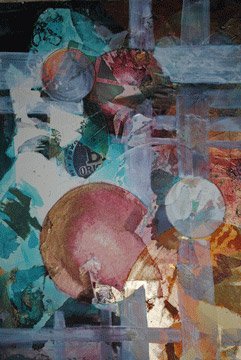 Dr. Mary Lou Hightower
Dr. Mary Lou Hightower,
associate professor of art education and director of the FOCUS
Gallery at the University of South Carolina Upstate in Spartanburg,
SC, had a mixed media art piece entitled "Circling Around
The Problem" accepted into the "South Carolina Watermedia
Society's 33rd Annual Exhibition" in Rock Hill, SC. Hightower's
work, which was selected from more than 200 entries, is on exhibit
in the Center for the Arts on Main Street Rock Hill from Oct.
2 to Nov. 19, 2010. The purpose of the South Carolina Watermedia
Society is to promote the aesthetic and professional interests
of its members and to provide the public with artistic opportunities
through watermedia painting; elevate the stature of watermedia
and educate the public to its significance as an important creative
permanent painting medium; further the interests of watermedia
painters by its programs and competitive exhibits, and to encourage
the study of watermedia painting; promulgate the highest aesthetic
standards within the visual arts, and to cooperate with and participate
in other similar organizations in order to stimulate the practice
and appreciation of the arts. For more information, contact Dr.
Mary Lou Hightower at 864/503-5817 or e-mail to (mhightower@uscupstate.edu).
The College of Charleston School of the Arts in Charleston, SC,
is proud to announce that Arts Management Program Director, Scott
Shanklin-Peterson, will receive the 2010 National Award for
Arts Achievement and Excellence from the International Council
of Fine Arts Deans (ICFAD). The award will be presented on Oct.
22, 2010, in Sarasota, FL. The award is presented to an organization
or a person who has contributed significantly toward the advocacy,
support, visibility or creativity within the arts. ICFAD's Board
of Directors, headed by Ron Jones, Dean of the College of the
Arts at the University of South Florida, selects the recipient
each year. The honor includes a $1,000 prize to a young artist
or arts organization as selected by the award recipient. Shanklin-Peterson
has designated the grant for the South Carolina Arts Alliance,
where she is the immediate past President of the Board. Currently
Shanklin-Peterson serves as the Director of the School of the
Arts' Arts Management Program. Her accomplishments include service
at the South Carolina Arts Commission, where she was Director
from 1980 to 1994, and her time at the National Endowment for
the Arts from 1994 to 2001, where she served as Senior Deputy
Chairman for four years. She serves on the boards of the Southern
Arts Federation, International Arts and Artists (Washington, DC)
and the International Advisory Committee for the Arts Council
of Mongolia. Organizations such as the National Art Education
Association have recognized Shanklin-Peterson's leadership in
the arts. The South Carolina Arts Alliance named its advocacy
award for her ("The Scottie"), and she was the first
recipient. She also has received the Order of the Palmetto from
Governor Richard Riley, the highest award for leadership and public
service that South Carolina's Governor presents, as well as the
Elizabeth O'Neill Verner Award for the Arts, South Carolina's
highest award in the arts. For further info contact Nandini B.
McCauley, Media Resources Coordinator, School of the Arts
College of Charleston, by calling 843/953-8228 or visit (http://www.cofc.edu/sota).
Jonathan Brilliant was named the winner of the first Play
With Your City competition hosted by the Columbia Design League
in Columbia, SC. Play With Your City is a new, annual public art
initiative that challenges how people think about urban spaces
by using downtown sites in exceptional and surprising ways. Designed
to support innovative approaches to public spaces within our community,
Brilliant's "Field of Good Fortune", was selected as
the winner and his project will receive $3,000 in funding. "Field
of Good Fortune" is a series of giant human-scale fortune
cookie fortunes installed in Main Street greenspaces, bearing
auspicious fortunes to Main Street passers by from the artist's
personal collection of paper fortunes. "This competition
is just the beginning of a new movement of public art in Columbia. It
seems so appropriate that the first Play With Your City public
art project features fortunes - our collective urban fortune should
read 'you will experience a great wealth of public art in the
near future,'" said Anna Redwine, Columbia Design League
president said. The Columbia Design League formed a public art
committee, whose members served as the jury to select the three
finalists, out of 13 entries, for the Play With Your City Face-off
event that was held Sept. 17, 2010. Award-winning New York City-based
arts writer, editor and blogger Teri Tynes returned to Columbia
to choose one project for the $3,000 funding award. Each finalist
had a few minutes to present their public art proposal and to
defend it in response to questions from Tynes, the audience and
even of other finalists. Tynes is the creator and writer of the
website, "Walking Off the Big Apple", a strolling guide
to New York arts and culture. She has also published articles
for "ArtPapers", "The Dallas Morning News",
the "Independent Film & Video Monthly", and other
publications. The Play With Your City competition is all about
innovative ways to look at our shared urban spaces and the judges
were seeking public art proposals that were outside of the box.
Playfulness is a key part of this initiative and all three finalists
(The 529 Collective, Kimi Maeda and Jonathan Brilliant) had a
visible element of play in their proposals. Beyond innovation
and playfulness, the judges considered these criteria: The proposed
project demonstrates an innovative approach to the location, materials
and/or topic; The proposed project promises a high quality of
craftsmanship, aesthetic maturity and artistry; It is clear that
the applicant has considered the specifics of the site, its users,
and its context within the community; The proposed public art
project will enhance the downtown area and the Columbia community;
The budget is reasonable and the available financial resources
will be adequate to complete the project; The project design is
feasible and well-planned; There is a clear plan for documenting
the proposed project; and The proposed public art project is appropriate
in terms of content and social dynamics. This project, created
by the Columbia Design League, an affiliate membership group of
the Columbia Museum of Art, is designed to foster innovative approaches
to shared spaces within our community. The goal of the initiative
is to demonstrate that effective, engaging public art can be produced
on a small budget and by all kinds of people. For further information
call 803799-2810 or visit (www.columbiamuseum.org).
The Carolina Foothills Artisan Center in Chesnee, SC, has
received a $90,000 grant from the USDA Rural Business Enterprise
Grant Program. This is one of 61 awards given across the country.
The money will be used to promote culture-centered tourism and
job creation. "We are very excited to receive a grant from
the USDA," Carolina Foothills Artisan Center Executive Director
Melia Brannon McCraw said. "This is an amazing opportunity
for us to continue our mission to promote the arts of the foothills
region. We hope to discover emerging artists in our region and
assist area artists in promoting and developing their craft."
This first part of the project will fund a study of Upstate artists
and create a database of artists in Anderson, Cherokee, Greenville,
Laurens, Oconee, Pickens, Spartanburg and Union counties. The
database and feasibility study will then be used to help artists
to better market their artwork. "One main goal in this project
is to help hobby and part-time artists to become full-time artists,"
McCraw said. The second part of the project will include the development
of a comprehensive website to promote and sell artwork from artists
in the region. McCraw added, "Many artists would like to
have a presence on the internet to showcase and sell their work.
This grant will allow them that opportunity, without having to
go to the expense of having their own individual websites."
The website will allow tourists and residents alike to find, enjoy
and purchase quality local artwork. The website will be controlled
by the Carolina Foothills Artisan Center. "Our hope is that
this grant will allow local artists to become fully supported
by their art," McCraw said. "The grant should also add
stability to the Artisan Center and allow us to expand our satellite
gallery program." The first satellite gallery of the Artisan
Center can be found inside Lillie's Antiques and Accessories in
downtown Cowpens, SC. Carolina Foothills Artisan Center provides
artists and artisans from South and North Carolina a permanent
gallery space in which to exhibit and sell their work. The Artisan
Center also offers opportunities to the community for increasing
cultural experiences and education. The Carolina Foothills Artisan
Center is a partner organization of The Arts Partnership of Greater
Spartanburg and also receives support from the South Carolina
Arts Commission. The Rural Business Enterprise Grant Program helps
to finance and facilitate the development of new and existing
businesses in rural America. Funds can be used for start-up and
working capital loans, building and plant renovations, transportation
improvements, project planning and other business needs. More
information about this program is available at (http://www.rurdev.usda.gov/BCP_rbeg.html).
Carolina Foothills Artisan Center is located at 124 West Cherokee
Street (Scenic Highway 11), Chesnee, SC. Hours of operation are
Mon.-Sat., 10am-5:30pm. Carolina Foothills Artisan Center is funded
in part by The Arts Partnership of Greater Spartanburg, its donors,
the County and City of Spartanburg, the City of Chesnee, and the
South Carolina Arts Commission which receives support from the
National Endowment for the Arts. For further info call 864/461-3050
or visit (www. cfac.us).
The Contemporaries, an affiliate group of the Columbia Museum of Art in Columbia, SC, dedicated to engaging young professionals in the arts, announces the addition of 13 new members to its board for the 2010-2012 term. The new Contemporaries board members are: Charles Applebee, Attorney, Collins and Lacy, P.C.; Kim Bryson, Senior Analyst, Decision Support, Providence Hospital; Julia Burley, Event Director, Lake Carolina & Inspired Communities; Harris Cohn, President, Cohn Construction Services, LLC; Jay Cross, Senior Analyst, SCANA Corporation; Amanda Drinkall, Account Executive, Cyberwoven; Kelly Hall, Assistant Attorney General, South Carolina Office of the Attorney General; Meg Hinson, Reporter, The Associated Press; Shigeharu Kobayashi, Owner, P-Bug Goods, LLC; Andrea Lance, Senior Project Assistance, BlueCross BlueShield of South Carolina; John McCardell, Vice President, Merrill Lynch; Asheley Scott, Architect, Studio 2LR Architecture + Interiors; and Ann Marie Stieritz, Vice President, Economic and Workforce Competitiveness. Returning Contemporaries board members are: Natalie Armstrong, Litigation Attorney, Solomon Law Group, LLC; Joan Boyer, Credit Analyst, National Bank of South Carolina; Emily Brady, Public Affairs Manager, Chernoff Newman; Rhett Brewer, Vice President, Carolina First; Ryan Coleman, Business Liaison, City of Columbia Community Development Department; Matt Congdon, Vice President, DCG Development Company; Emma Dean, Associate, Nelson Mullins Riley and Scarborough; Ryan Hyler, Research and Marketing Director, Colliers International; Trey Price, Vice President, Ace Glass Company, Inc.; and Debi Schadel, Owner of her own PR and Event Planning firm. Board officers include Joan Boyer, president; Emily Brady, vice president; Ryan Coleman, treasurer; and Matt Congdon, secretary. This year the Contemporaries added a new position to the board, artist liaison, with the purpose of reaching out to the local arts community and representing the board on the museum's public programming advisory committee (PPAC). The board has appointed Shigeharu Kobayashi, a local artist with specialty in graphic design, painting and drawing, as the artist liaison, and he will assist the Contemporaries with their art acquisition project and Contemporaries Artist of the Year competition. "We are excited to welcome these talented, young professionals to the Contemporaries board," said Columbia Museum of Art executive director, Karen Brosius. "The Contemporaries are valuable museum members and because of their strong fundraising and arts acquisitions efforts our museum is now home to a Dale Chihuly chandelier. We look forward to seeing this group's continued growth," she added. The Contemporaries host many cultural and social events, and some of their fall 2010 events include Oktoberfest on Wednesday, Sept. 22, 2010, on Boyd Plaza and their signature black-tie event, the 5th annual Black and White Ball: An Evening with Hitchcock, on Friday, Oct. 29, 2010. For more information about these events, the Contemporaries and membership, visit (www.columbiamuseum.org) or contact Todd Buehrig by e-mail at (toddb@columbiamuseum.org) or call at 803/343-2198. The Contemporaries of the Columbia Museum of Art are comprised of an active membership of over 200 young professionals from the Columbia area. The mission of the Contemporaries is to provide an opportunity to support the Museum through: promoting the Museum and its programs, diversifying the Museum's membership, and leading the next generation of Museum supporters. The Columbia Museum of Art is South Carolina's premier international art museum and houses a world-class collection of European and American art. Founded in 1950, the Museum opened its new building on Main Street in 1998 with 25 galleries. The collection includes masterpieces of the Italian Renaissance, Baroque and Rococo from the Samuel H. Kress Collection, porcelain and works by significant furniture and silver makers, as well as American, Asian, and modern and contemporary art. In recent years the Museum's collection of Asian art and Antiquities has grown through generous gifts to the collection. Of particular interest are Sandro Botticelli's "Nativity", Claude Monet's "The Seine at Giverny", Canaletto's "View of the Molo", and art glass by Louis Comfort Tiffany. The Museum's newly commissioned Chihuly chandelier is now on view in the Museum's David Wallace Robinson, Jr. Atrium. The Museum offers changing exhibitions from renowned museums as well as educational programs for all ages that include art classes, art camps, lectures, films and concerts. It is the recipient of a National Art Education Association award for its contributions to arts education and an Elizabeth O'Neill Verner Governor's Award for the Arts for outstanding contributions to the arts in South Carolina. Generous support to the Museum is provided by the City of Columbia, Richland County, the South Carolina Arts Commission and the Cultural Council of Richland and Lexington Counties. For further information call 803/799.2810 or visit (www.columbiamuseum.org).
The Columbia Museum of Art in Columbia, SC, is pleased to announce director of development Scott Nolan has been selected for the 2011 class of Leadership Columbia. Nolan has been in fundraising for 10 years and joined the Museum in 2008. Originally from New Jersey, Nolan received degrees from Eckerd College in Florida and American University in Washington, DC. Prior to joining the Museum, Nolan launched a major and planned gifts effort at WUSF Public Broadcasting in Tampa, FL, raising funds for Tampa Bay's NPR radio affiliate and PBS station. Nolan serves the community as an active member in the Capital Rotary. "I am sincerely and deeply excited to participate in Leadership Columbia 2011," Nolan said. "The arts are a critical part of our community and I'm eager to help enrich the class in that way. I look forward to the opportunity to get to know my classmates and am eager to make my contribution through the enrichment programs and the class project." The Greater Columbia Chamber of Commerce has sponsored the Leadership Columbia program for more than 30 years. The program provides existing and emerging leaders with opportunities to enhance their civic knowledge and civic network, help participants better understand how our community works and provide opportunities for building relationships with the region's current and future leaders. Through their participation, participants develop the leadership skills necessary to assume leadership roles and become inspired to focus talents in a way that will best serve the community. For further info call the Museum at 803/799.2810 or visit (www.columbiamuseum.org).
The Board of Directors of The Arts Council of Henderson County in Hendersonville, NC, invites arts and cultural nonprofit organizations and businesses to attend a meeting and reception, Monday, Nov. 15, 2010, from 5:30 7:30pm at The Arts Council, 538 North Main Street, 2nd Floor in downtown Hendersonville. This meeting is an opportunity for representatives from all Henderson County arts and cultural organizations and businesses to meet, share ideas, and possibly develop new partnerships. There will be a brief program with scheduled speakers Vincent Marini, Producing Artistic Director, Flat Rock Playhouse, Gene Hamme, Board President, Hendersonville Symphony Orchestra, and Doug Jarvis, Board President, The Arts Council of Henderson County. The topic is "Change and Evolution" and each speaker will talk about the changes and evolution that their organizations are undergoing. Individual visual and performing artists, and people interested in the future of the arts and culture in Henderson County, are also welcome to attend. "It is important for the arts and cultural community to share their organizations' stories of how they have chosen to handle change," said Arts Council Executive Director Jim Faucett. "This gathering is also meant to be an opportunity to simply socialize and get to know each other better." Refreshments will be served. Please RSVP to The Arts Council at 828/693-8504 or e-mail to (acofhc@bellsouth.net). The Arts Council of Henderson County is a community organization that promotes, advocates for and nurtures the arts in Henderson County and western North Carolina. The Arts Council gallery and offices are handicapped accessible. The Arts Council is supported in part by the North Carolina Arts Council, the State of North Carolina, the Community Foundation of Henderson County, Henderson County, and the Henderson County Travel and Tourism Bureau. For more information contact The Arts Council of Henderson County at 828/693-8504 or visit (www.acofhc.org).
Author and illustrator Tony Waters of
Charleston, SC, announces the publication of his newest book,
"Sleep, Little Child", which is adapted from an original
lullaby by North Carolina author/musician Marc Hoffman. Waters
created the illustrations and cover art for the book and the accompanying
CD of the lullaby. "Sleep, Little Child" is a rhyming
story in which a father assures his young son that he will sleep
safely through the night because his heavenly Father is always
watching over him. The book is intended for children from infancy
through age seven. Tony Waters was on hand for the August 27 book
launch and signing party at the Literary Bookpost in Salisbury,
NC. Well over 100 people attended, including over 50 children
who came to hear the author perform the lullaby. Owner Deal Safrit
reported that it was the store's best sales day since opening.
On the following Sunday "Sleep, Little Child" topped
the store's bestsellers list. For the artwork, which depicts a
young family putting their small son to bed at night, Waters said
he used watercolors because "they allow some freedom for
change or spontaneity." He explained his inspiration for
the illustrations: "Details inspire me, which is why I asked
Marc for pictures of his family and childhood things. I also used
some of the rooms and furnishings in my own house as a setting
for the story. When I'm writing or illustrating a book, I'm inspired
by the things - toys, books, artists, emotions - that gave me
joy as a child and the desire to share that joy with other children.
This adds a certain 'realness' to the drawings." Another
advantage with detailed pictures for children, Waters said, is
that "when children notice something new the next time they
look at a book, they are encouraged to return to the book more
and more to look for other details. In "Sleep, Little Child",
the boy's quilt offers a lot of things to hunt for, and some children
may even look for discrepancies in the drawings from one page
to another." Born and raised in Charleston, Waters has written
and illustrated three children's books of his own entitled "The
Sailor's Bride", "The Moon Smiles Down", and "Cinnamon's
Busy Year". In addition he has illustrated four Flick books
for Columbia, SC, author Lynn Floyd Wright, The Big Batby Anne
Jewell, Director of the Louisville Slugger Bat Museum, and several
supplemental education workbooks. He has also contributed numerous
illustrations for the Cricket Magazine Group over the past 16
years. "Sleep, Little Child" includes an accompanying
CD that features Hoffman singing his original lullaby. Other tracks
offer the instrumental-only version, plus two non-musical readings:
one by the author and another by the author's mother and radio
personality, Barbara Hoffman. Hoffman published the book through
own label, Virillion Music, to retain the rights for a second
edition. He interviewed several artists before finding Tony Waters,
then selected Asia Pacific Offset Printing, a company that publishes
materials for the Smithsonian Institution, as his printer. "Sleep,
Little Child" is also available online at (www.sleeplittlechild.com)
and on Amazon. For more information and to hear the lullaby, visit
(www.sleeplittlechild.com).
The National Sculpture Society in New York, NY, is pleased to
announce the election of sixteen new Sculptor Members. Hailing
from the east coast to the west coast, the sculptors demonstrate
talent and skill in the diverse subject matters and mediums of
their sculptures. Alex Palkovich of Florence, SC, is now
part of this select group of Sculptor Members. Currently, Palkovich
is the only Sculptor Member in South Carolina. The remaining newly
elected Sculptor Members (in alphabetical order) are: Richard
Becker (CA); George Bumann (WY); Darrell Davis (TX); Martin Thomas
Gates (FL); Jay F. Goldstein (PA); Ben Hammond (UT); Stephen C.
Layne (PA); Jan Mapes (AZ); Lauren Mills (MA); Eugene Morelli
(MT); Tanya Ragir (CA); Roger Reutimann (CO); Chris Riccardo (FL);
Stephen C. Spears (AL); David H. Turner (VA). Those designated
as NSS Sculptor Members and Fellows total less than 200 nationally.
In 1893, founding members, including Daniel Chester French, Augustus
St. Gaudens, and Stanford White, established the Society to "spread
the knowledge of good sculpture." Today, NSS continues to
support sculpture as an active, vital, not-for-profit organization.
NSS' programs include Sculpture Review magazine, the NSS News
Bulletin, scholarships, the Alex J. Ettl Grant and rotating exhibitions.
These educational programs are just a few of the ways NSS serves
as a link between the public, sculptors and collectors. For more
information contact Gwen Pier by e-mail at (gwen@nationalsculpture.org)
or visit (www.nationalsculpture.org).
The Arts Partnership of Greater Spartanburg in Spartanburg, SC, announced today that Jennifer Evins has joined the Arts Partnership staff as Director of Development. In that role, Evins will be responsible for directing the development and marketing efforts for The Arts Partnership and The Chapman Cultural Center. "I am delighted to welcome Jennifer to The Arts Partnership staff," said H. Perry Mixter, President and Chief Operating Officer of The Arts Partnership. Her knowledge and experience in development work are second only to her passion for arts and culture and how they can best serve the Spartanburg community." Tommy Young, Chairman of The Arts Partnership's Board of Trustees, said, "Jennifer played an essential role in the vision for and funding of the Chapman Cultural Center, and I can think of no more appropriate role for her to play now than to direct the fund raising efforts for the operations and programs of this great facility and the organizations housed here." Evins has been most notably known for chairing the Capital Campaign for the Chapman Cultural Center Project and has served as a volunteer in the arts in Spartanburg since 1995. She served recently as Executive Chair for the City of Spartanburg's Creative Energy Initiative and inaugural Chair of Spartanburg Creative Taste. In past years she has served on the boards of Ballet Spartanburg, the Music Foundation and The Arts Partnership. Evins currently serves as one of seven Trustees of the Spartanburg County Foundation and an appointed member of the City of Spartanburg's Public Safety Commission. She is one of ten members serving on the inaugural Board of The College Hub of Spartanburg County to improve educational achievement in Spartanburg County. In the last two years, Evins has been instrumental in helping the YMCA of Greater Spartanburg raise over $4 million to build a new Family YMCA at the Pine Street location. Her first job was when she was fifteen as a gate attendant in an Indianapolis city park, followed by college internships for the Tenth Pan American Games and the Indianapolis Convention Center. After graduating from Hanover College, Evins had a professional career in marketing and public affairs. Her last assignment was as Public Affairs Director at WSPA-TV, NewsChannel 7. The Arts Partnership owns and operates The Chapman Cultural Center and provides financial support for arts education and cultural programming in Spartanburg County. The Arts Partnership provides major operating support for eight county-wide cultural agencies including The Spartanburg Science Center, The Historical Association, The Artist Guild, Ballet Spartanburg, The Music Foundation, Carolina Foothills Artisan Center, The Spartanburg Museum of Art and The Spartanburg Little Theater and Youth Theater. For further info call Perry Mixter at 864/278-9669.
The 6th Annual Antique Bikes on Main
was held on July 25, 2010, in downtown Chesnee, SC. Despite temperatures
reaching 108° F, a record estimated crowd of 10,000 attendees
and 6,000 motorcycles was in attendance. Attendees and vendors
reported traveling from as far away as VA, FL, and the Memphis,
TN, area to participate in this year's free event. The event was
hosted by Chesnee Classic Cycles, sponsored by the Northeast Area
Council and dedicated to the late J. M. "Hoover" Hayes.
Net proceeds will be equally divided between Chesnee's Carolina
Foothills Artisan Center and the Chesnee Head Start Program. Each
organization will be presented a check, in memory of "Hoover"
Hayes, during the Aug. 9, 2010 Chesnee City Council Meeting at
Chesnee City Hall. For further info call Dennis Harris at 864/590-2141,
Clint Button at 864/814-6418 or visit (www.antiquebikesonmain.com).
Hand papermaking artist Jocelyn Chateauvert has been awarded
the Smithsonian Artist Research Fellowship to study the sculptural
qualities of plants life and the art of botanical illustration
in the jungles of Guyiana, South America. She is the first artist
in a craft medium to be granted the Smithsonian Fellowship, and
the first to study in Guyana. She will spend 18 days this summer
and return again in December to the sparsely populated country
at the north end of the Amazon rainforest documenting the variety,
diversity, and stunning beauty of the roughly 53,000 plant species
in the region. Chateauvert, who has been using handmade paper
to create plant sculptures for over 20 years, intends to bring
a direct botanical understanding by observation of plant life
to her art. As she wrote in her fellowship application: "My
passion to transform handmade paper into an emotional representation
of plant life will be informed with a greater knowledge of its
structure, physical attributes and species relationships."
Chateauvert has been researching the biological holdings of the
Guyiana shield at the herbarium of the Smithsonian's National
Museum of Natural History and studying botanical illustration
for the past month in preparation for her travels. Raised in Iowa
and a longtime resident of the live oaks, marshes and dunes of
Charleston, SC, Chateauvert has a strong connection to plants
and has devoted her life to, as she says, "Transforming plant-based
paper into plant-themed inspired artwork." She has won numerous
awards and been featured in exhibits nationally and internationally
and everywhere in between. She holds a Master of Arts and a Master
of Fine Arts degree from the University of Iowa. The Smithsonian
Fellowship is granted each year to 12 artists, giving them the
opportunity to study their craft virtually anywhere in the world.
For information regarding the Smithsonian Artist Research Fellowship
contact Will Morrison by e-mail at (morrisonb@si.edu).
The Coastal Community Foundation in Charleston, SC, named Elizabeth McKeever as the 2010 Griffith/Reyburn Lowcountry Artist of the Year. She will receive $5,000 to support her artistic pursuits and the creation of an oil-on-canvas piece representative of Lowcountry culture. She competed with 23 other artists in a rigorous application and Panel Review process to win. "This award would allow me to enroll my son in a pre-school program, giving me more time to paint," said McKeever. She went on to say, "Increased work hours and visibility will help me further my long-term goals, including that of obtaining local gallery representation." Mike Griffith and Donna Reyburn established the Griffith/Reyburn Lowcountry Artist Award Fund of Coastal Community Foundation in 2003 to support the work of visual artists who create works of art that reflect Lowcountry culture. Each year applications are accepted from Charleston County residents. The award ($5,000) is intended to support the creation of a work of art which will then be the personal property of the artist to keep, show, give away, or sell. Qualified applicants for the award must complete a brief application form and submit it to a review panel. The panel then convenes to select the winner based on the applicants' answers to each question. The final choice is made on how close those answers resonate with the mission of the Griffith/Reyburn Lowcountry Artist Award Fund of Coastal Community Foundation, which is to promote the Lowcountry through the work of the local visual artists in Charleston County. Elizabeth McKeever is a local Charleston artist with a recent calling to landscape scenes as a metaphor for the spiritual and emotional state. She went to college on an academic scholarship with the intent to pursue law and politics, but then chose to become an artist. "The choice to become an artist was not a light matter for me, because I knew that the path would be more uncertain and require a strong amount of self-reliance," said McKeever justifying her decision for the change. After receiving her B.A. in studio art and a minor in philosophy, McKeever worked in advertising for one year before returning to graduate school. She was selected as the first artist-in-residence for the Gibbes Museum of Art and taught art classes to adults there for seven years. In the past she has also done interior design work and waited on tables for supplemental income. Now, she has her own business, is married, and the proud parent of an almost 4-year-old. Established in 1974, Coastal Community Foundation is a public grant making foundation fostering philanthropy for the lasting good of the community in Beaufort, Berkeley, Charleston, Colleton, Dorchester, Georgetown, Hampton and Jasper Counties. Thousands of families, businesses, individuals and organizations have built over 550 individual funds and endowments at the Foundation to benefit specific charities and/or broad areas of community life education, basic human needs, conservation and preservation, arts, health and neighborhood/community development. In its 36-year history, Coastal Community Foundation has awarded more than $98.5 million in grants and manages assets in excess of $130 million. Last year, Foundation funds generated over $12.3 million for charitable programming, community projects, educational initiatives and scholarships. To learn more visit (www.CoastalCommunityFoundation.org).
For fiscal year 2010/2011, the Gibbes Museum of Art, in Charleston, SC, is pleased to announce two new hires and several staff promotions. On June 29, 2010, Lasley Poe Steever joined the museum in the newly created position of Program and Events Manager. Meredith Siemens joins the Gibbes today as Rental Events Coordinator. The new fiscal year brought the promotion of several staff members including Sara Arnold, former Associate Curator of Collections and now Curator of Collections, Marla Loftus, former Director of Communications and now Director of Museum Relations, Rebecca Sailor, former Education and Outreach Coordinator and now Associate Curator of Education, Janet Scarborough, former Director of Finance and Administration and now Chief Financial Officer, and Pam Wall, former Associate Curator of Exhibitions and Interpretation and now Curator of Exhibitions. Prior to joining the Gibbes as Program and Events Manager, Steever worked in special events for the 2010 Spoleto Festival USA. Before moving to Charleston in 2009, Steever worked at the Metropolitan Museum of Art. She joined the Met in 1998 where her positions included Managing Editor for the Heilbrunn Timeline of Art History and Website Content Manager. Steever is a 1996 Cum Laude graduate of Duke University where she earned a Bachelor of Arts in Art History and Fine Art. As Program and Events Manager, Steever will manage all internal and external museum programs. In addition to her new role as Rental Events Coordinator for the Gibbes, Meredith Siemens runs Code Red Consulting, a communications firm that specializes in marketing for lifestyle clients. Prior to Code Red Consulting, she served as Editor for "Where Magazine". Siemens is a 2005 graduate of DePauw University where she earned her Bachelor of Arts in Communications & English Writing. She is involved in many community organizations and events including the BB&T Charleston Wine & Food Festival, Spoleto SCENE, Charleston Young Professionals, and Covered in Blue Colon Cancer Awareness. As Rental Events Coordinator for the Gibbes, Siemens will promote the museum as a premier rental venue in the Charleston area. Established as the Carolina Art Association in 1858, the Gibbes Museum of Art opened its doors to the public in 1905. Located in Charleston's historic district, the Gibbes houses a premier collection of over 10,000 works, principally American with a Charleston or Southern connection and presents special exhibitions throughout the year. In addition, the museum offers an extensive complement of public programming and educational outreach initiatives that serve the community by stimulating creative expression and improving the region's superb quality of life. For further information visit (www.gibbesmuseum.org).
A pair of bodypaint artists from North Carolina's Piedmont Triad region earned the right to be called World Champions at The 2010 World Bodypainting Festival competition held in Seeboden, Austria. Scott Fray and Madelyn Greco of Team LivingBrush walked away with second place in the category "World Award - Brush & Sponge" after two days of executing designs that were presented before a jury of globally distinguished artists. The "Brush & Sponge" category, closest to classical painting, is marked by designs meticulously executed by hand. Artistic teams are limited to two bodypainters and each design must be completed in 6 hours' time; prior to judging, photography and a glamorous stage presentation similar in scope to a large outdoor concert. The World Bodypainting Festival draws around 30,000 visitors each year to Seeboden, located on picturesque Lake Millstatter See in the South of Austria. Billed as "Europe's Most Colourful Event", forty-eight countries have come to be represented in the competition since the festival's inception, ten years ago. The 2010 World event was Fray & Greco's second bodypainting competition. They tied for first place after the preliminaries and placed second in a field of 36 finalists behind a Canadian artist. The pair established their World Class potential competing for the first time just five months earlier in 2010, when they became the top-finishing US artists at the North American Bodypainting Championships in Las Vegas. Last year's first place World Champions, a US team who did not compete at the North American Championships, finished fourth in the world this year. Fray and Greco, an engaged couple residing in Reidsville, NC, are thrilled with the success of their first World Competition and have been honing their skills as a team for the past 6 years. The pair met by chance when Greco was drawn to Fray through his bodypaint artistry on display at a festival. Fray grew up in Michigan and received an education from the Center of Creative Studies College of Art and Design in Detroit. Greco was born and raised in Erie, PA, and graduated from The Art Institute of Pittsburgh, where she resided prior to moving to North Carolina. Other professional distinctions for the couple include a standing Guinness World Record, set in 2007 for painting the most people in a 24-hour period. For further info about the World Bodypainting Festival visit (www.bodypainting-festival.com). For further info about LivingBrush Bodypainting visit (www.livingbrush.com), call Scott Fray at 336/541-0630 or Madelyn Greco at 336/541-0632.
Redux Contemporary Art Center in Charleston, SC, announces the award of a $70,000 program grant from the esteemed Andy Warhol Foundation for the Visual Arts for two-year exhibition support. Established in 1987 in accordance with Warhol's will, the foundation's objective is to foster innovative artistic expression and the creative processes that support artists and their work. The Foundation values the contribution that organizations like Redux make to artists and audiences and to society as a whole by supporting, exhibiting and interpreting a broad spectrum of contemporary artistic practice. The Foundation is focused primarily on supporting work of a challenging and often experimental nature. In this regard the Foundation encourages curatorial research leading to new scholarship in the field of contemporary art. The Foundation is committed to the precept that the arts are essential to an open, enlightened democracy. It therefore seeks to advance an inclusive cultural dialogue by providing resources to organizations that support artists reflecting a diverse society and by affirming that freedom of artistic expression is fundamental to such a society and must be vigorously protected. To advance these values, grants are awarded to not-for-profit organizations in the United States. Today Andy Warhol's impact on artists, art institutions and the creative culture of our country is stronger than ever. The Foundation's programs and initiatives continue to evolve and expand to address the needs of the visual arts community nationwide. Over the past seven years, the exhibition program at Redux has expanded to include international and national artists whose work has never been exhibited in South Carolina. Through their work, these artists introduce Charleston to issues in contemporary art that would be nearly unavailable to the public otherwise. The exhibitions at Redux showcase artists who ask tough questions and make works that please, astonish and sometimes unsettle audiences. Working with a limited budget and support from the community, Redux has managed to bring many outstanding, challenging contemporary artists to Charleston. Redux currently presents six to eight exhibitions a year, featuring work by internationally renowned and local, emerging and mid-career artists. As Redux moves into its eighth year, these funds will provide additional support for its innovative and thought-provoking exhibitions, lectures, films and artist residencies. For more information, please contact Redux Contemporary Art Center at 843/722-0697 or visit (www.reduxstudios.org).
The Society of Bluffton Artists (SoBA) in Bluffton, SC, announces their recently elected Board of Directors for 2010-2011. The officers include: President - Chris Clayton; Vice President - Howard Ramey; Treasurer- Steve Wilson; Recording Secretary - Bonnie Mason; Corresponding Secretary - Dee Johnson; Publicity - Sandra Wenig; Gallery Manager - Cathy Cooney; Volunteer Coordinator - Pat Gardiner; Membership - Judy Weissman; Member at Large - Arturo Iriarte; Adult and Children's Classes - Mary Ann Putzier; and Public Relations - Dave Dickson. The Society of Bluffton Artists' Gallery is located in historic Old Town Bluffton. The spacious gallery provides an elegant display of original oil, watercolor, mixed media, acrylic and pastel paintings, photography and sculpture by local and regional artists. For further info call 843-757-6586 or visit (www.sobagalleries.com).
The North Carolina Pottery Center in Seagrove, NC, in partnership with Leland Little Auction and Estate Sales, Ltd. is pleased to announce that we have raised $24,800 at the 11th Annual Benefit Auction "Going, Going, Gone To Pots!" held Sunday afternoon, April 25th, 2010, at the North Carolina Pottery Center in Seagrove. The auction featured over one hundred fifty pieces of fine contemporary and historical North Carolina pottery. The evening was made possible through the generosity of North Carolina potters and collectors, Signature Sponsors: Community One Bank, First Bank, and Leland Little Auction and Estate Sales, Ltd., along with Gold Sponsors: Progress Energy, Insurance Associates of the Triad, Total Communications, the Umstead Hotel and Spa, Sodexho, and Pugh Funeral Home. Our Silver sponsors were Cabot Cheese, Seagrove Stoneware Inn, Eco Ornaments, Duck Smith House, Village Printing, Rock Ola Cafe, Klaussner Foundation, Kirk McNaughton and Linda Carnes-McNaughton, Energizer Battery, Asheboro, and the NC Zoological Society. Our volunteers were many and they made this a wonderful event. The Auction Committee comprised of the NCPC Board members, the NCPC staff and Bonnie Burns and Dick and Joanne Peterson put in many hours planning and fund raising. During the Auction Preview hour Bluegrass music was featured by Matthew Nance and friends and attendees enjoyed a light buffet. Exhibitions are made possible through the generosity of our membership, the North Carolina Arts Council, the National Endowment for the Arts Institute of Museum and Library Services, the Mary and Elliott Wood Foundation and the Goodnight Educational Foundation. Thank you! The mission of the North Carolina Pottery Center is to promote public awareness of and appreciation for the history, heritage, and ongoing tradition of pottery making in North Carolina. The Center is located at 233 East Avenue in Seagrove, NC. For more information, please call 336/873-8430 or visit (www.ncpotterycenter.org).
The second annual Give & Take spring fundraiser held at Artspace in Raleigh, NC, had another successful year, thanks to our donating artists, event sponsors, and all those who attended the event and/or purchased artwork. This year's event raised more than $6,500, a new record for Give & Take! Thank you to our sponsors, Poyner Spruill LLP and Raleigh Downtowner, as well as the 75 artists who donated pieces to the event, the Bowerbirds for an awesome performance, and to everyone who joined us for the evening. Proceeds from Give & Take go to the Artspace Scholarship Fund. The scholarship fund allows Artspace to provide full tuition for up to 50 students to attend Summer Arts Program classes each year. With the success of this event, we hope to extend scholarships also to our many other classes and workshops for children and adults throughout the year. Thank you for inspiring creative energy in tomorrow's artists! Artspace, a thriving visual art center located in downtown Raleigh, brings the creative process to life through inspiring and engaging education and community outreach programming, a dynamic environment of over 30 professional artists studios, and nationally acclaimed exhibitions. Approximately 95 artists hold professional memberships in the Artspace Artists Association. Thirty-five of these artists have studios located at Artspace. Artspace is located in Historic City Market in Raleigh at the corner of Blount and Davie Streets. Artspace is supported by the North Carolina Arts Council, the United Arts Council of Raleigh and Wake County, the Raleigh Arts Commission, individuals, corporations, and private foundations. For more information visit (www.artspacenc.org).
The Art Institute of Charleston, a branch of The Art Institute of Atlanta, will be holding its inaugural commencement exercises on June 19, 2010, at 10am at the Charleston Music Hall at 37 John Street in downtown Charleston, SC. Up to fifty students will be receiving diplomas, including those invited to "walk" at the ceremony from past graduating classes. Mayor Joseph P. Riley, Jr., who was instrumental in recruiting The Art Institute to Charleston, will deliver the graduation address. The Art Institute of Charleston opened its doors in April 2007, starting with a total of 59 students. By the fall of 2009, there were nearly 700 students in the total student body. President Richard Jerue of The Art Institute of Charleston shares that it was a challenge opening an Art Institute in Charleston, "There had never been an Art Institute in a city with such a small population as Charleston, and there were some who thought it just couldn't be successful." says Jerue. "But as city leaders looked closer, seeing we were a whole lot more than a culinary school, and as Art Institute leaders realized that the architectural, cultural and hospitality richness of Charleston matched perfectly with all that an Art Institute could offer, it became clear this could be an excellent fit." The proof is in the enrollment numbers which have consistently been exceeding expectations. At the ceremony, graduates will be receiving diplomas: Associate in Arts in Graphic Design, Bachelor of Fine Arts in Graphic Design, Associate in Arts in Web Design & Interactive Media, Certificate in Culinary Arts, Associate in Arts in Culinary Arts, Associate in Arts in Culinary Arts with a concentration in Baking & Pastry, Bachelor of Science in Culinary Arts Management, Certificate in Commercial Photography, Bachelor of Fine Arts in Photographic Imaging and Bachelor of Fine Arts in Interior Design. Academic Dean Dr. Esther Kramer says, "When you start a new school, it takes a while to build up to a significant amount of graduates. In the past, we have had a handful of graduates at the end of various quarters and we have held celebration dinners for these students and their families. Now, we are at a point where a full graduation ceremony is in order, and all past graduates are invited to participate on June 19th." In keeping with The Art Institute of Charleston's commitment to the community and cutting edge spirit, it is fitting that graduating students and faculty members will, for the first time in the state, wear "green" gowns at the ceremony. These robes are a new, environmentally friendly way to keep the traditional academic regalia in place, while helping to insure a sustainable future. The gowns are made entirely from recycled plastics made from 100% post-consumer plastic bottles taken from landfills. The robes are made by a company called Green Weaver, who states that to date, 3.5 million bottles have been reclaimed to produce these gowns. The Art Institute of Charleston, a branch of The Art Institute of Atlanta, is one of The Art Institutes, a system of over 45 schools located throughout North America, and is centrally located in downtown Charleston with the main campus at 24 North Market Street, and a satellite campus at Fountain Walk on Charleston's harbor front at 360 Concord Street. The college offers degree programs in Culinary Arts; Wine, Spirits & Beverage Management; Graphic Design; Interior Design; Web Design & Interactive Media; Photographic Imaging; Fashion & Retail Management and Digital Filmmaking & Video Production. For more information visit (www.artinstitutes.edu/charleston).
The HUB-BUB Artists-in-Residence Program (Spartanburg, SC) is pleased to announce the incoming 2010/11 group of residents. Corinne Manning, Ian Shelly, Kerri Ammirata and Ron Longsdorf will move to Spartanburg on June 15, 2010, and spend the next 11 months making work and getting involved in community based art projects specific to their personal interests. Each year, HUB-BUB invites three emerging young visual artists and one creative writer to "live free and create" in studio apartments located above the Showroom Gallery in the HUB-BUB building. HUB-BUB is quickly gaining recognition as a top national community-based residency program; this year over 160 artists/writers from across the country applied for the four spots. The artists/writer who were chosen stood out for the quality of their work and their interest in community service. Corinne Manning is a fiction writer with an MFA in Creative Writing from UNC Willmington. Her time in Spartanburg will be spent working on her novel "Potential Monsters" and acting as an intern for the Hub City Writers Project. This is an exciting opportunity especially with the opening of Hub City's downtown community bookstore. Ian Shelly is a ceramicist with an MFA from U. Missouri. A west Texas native, he plans to spend his time exploring ceramic sculpture inspired by science and military weaponry. He has vast teaching experience and hopes to transition his teaching philosophy of interaction, application and enjoyment into service in the Spartanburg community. Kerri Ammirata is a painter and printmaker with an MFA from U Boston. A trained landscape painter, her current work is inspired by Australian Aboriginal art. Ammirata looks forward to teaching workshops and getting connected to the local community. Ron Longsdorf is a sculptor with an MFA from U Deleware. His installation work explores the connections to personal relationships, places and objects. He hopes to get the community involved in a collaborative participatory project. To learn more about the HUB-BUB artists-in-residence, visit (www.HUB-BUB.com).
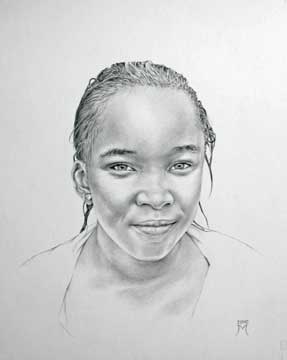 Melissa Gravano
Walterboro, SC, artist, Melissa Gravano's portrait of "Ashila", was selected for the 2010 Piccolo Spoleto Festival Juried Art Exhibition. Margaret Hoybach, the painting/2-D juror for the show, selected a total of 65 diverse and stimulating works from the 272 pieces submitted. The exhibition promises to provide an excellent display from a diverse and talented group of talented South Carolina artists. The exhibition is free and open to the public between 8:30am and 5pm, from May 28 through June 11, 2010, and will be on display at the Charleston Visitor Center, 375 Meeting Street in Downtown Charleston. For further info call Gravano at 843-908-1677.
The Center for Craft, Creativity and Design (CCCD) in Hendersonville, NC, is pleased to announce the ten Windgate Fellowships and four Windgate Museum Internships for 2010. This is the fifth year of awarding students in these two programs, supported by the Windgate Charitable Foundation and administered by the Center for Craft, Creativity and Design. To date, the Windgate Fellowship program has awarded a total of $750,000 to 50 graduating seniors working in a craft medium representing 30 colleges and universities in 20 states. For the Windgate Museum Internship program, the CCCD has worked with 11 museums across the US and in the UK, awarding a total of $100,000 to 20 undergraduate and graduate students from 16 universities. Each of the ten Windgate Fellows, a graduating senior whose work relates to craft, will receive $15,000 to complete an 18-month proposal that will propel their career forward after they complete their undergraduate degree. These fellows were selected from 92 applications representing 50 universities from throughout the United States. Universities with a strong craft program were invited to each nominate two graduating seniors for this prestigious fellowship. This year's recipients are: Dustin Farnsworth, BFA Woodworking/Functional Art, Kendall College of Art and Design of Ferris State University. With the fellowship, I plan to move to Asheville, NC, and over the course of a year work for three or more makers whose work varies in style and material, each for a three-month period. Working for established makers at varying levels of sustainability, I hope to refine my craft while developing the mastery of wood and steel necessary to become a self-sustained craftsman. Amy Hamai, BA, Metal, San Diego State University. My perfect 18 months will involve attending workshops at Penland School of Crafts and Haystack Mountain School of Crafts to refine my technical abilities in jewelry making and to attend conferences and trade shows (SBAG Seattle, SOFA Chicago and ACC Baltimore) to broaden my awareness of contemporary craft conversations and insights into the professional world. I will also set up a longed for studio space to work on a body of work. Daniel Icaza, BFA Metals/Jewelry, Arizona State University. I will expand upon my current series of art by using more valuable materials that will strengthen the series, as well as establishing my own studio where I can continue my craft and become an independent artist/jeweler. The majority of the Fellowship will be used to procure equipment and to purchase raw materials to produce work. Alexis Myre, BFA, Jewelry/metal arts, California College of the Arts. During the fellowship I will first address the kinetic aspects of my work by attending Arthur Ganson's workshop at Haystack Mountain School of Crafts. After Haystack I will visit New Mexico to research the use of symbolism in the traditional crafts of Taos, Jemez and San Ildefonso Pueblos. During my stay I will attend SOFA West and visit various galleries for exposure to the professional contemporary side of craft. My dream is to create a carefully crafted kinetic installation, where the objects come to life and the wall pieces serve as backdrops and diagrammatical explanations to tell a collaborative story. Rachael Nyhus, BFA, Metal Arts, California College of the Arts. With the Windgate fellowship I will travel to Italy for a workshop with Valentin Yotkov, a master of chasing and repousse. Subsequently I will go to Bulgaria where I will study the Thracian treasure, an exquisite example of those techniques. I will also attend Terra Madre in Torino, Italy. Terra Madre will provide me with valuable insight and knowledge into the emerging food revolution. When I return to the Bay Area, I envision starting a studio where I can create a body of work informed by these experiences. Benjamin Reid, BFA sculpture, University of North Carolina Asheville. I will use the fellowship to pay the cost of two summer classes at Penland School of Crafts, taught by Yuri Kobayashi and Deb Stoner. I will enroll in a series of courses at Wake Technical Community College that cover machining, computer numerical controlled milling and CNC programming. To explore the roots of my design aesthetics, I will visit the Smithsonian National Air and Space Museum in Washington, DC, three nautical museums in South Carolina, New York and Connecticut, the entomology collection at the Smithsonian Museum of Natural History and Philadelphia Insectarium. With the remaining funds I will outfit and supply a personal studio and create a body of work. David Skaurud, BFA Furniture, Minneapolis College of Art and Design. With the Fellowship I will attend workshops, acquire essential studio equipment, and travel to furniture shows. The workshops will include a titanium frame building class at UBI, and bladesmith and metalsmith classes. I will be able to purchase a TIG welding machine, an anvil and leather rated sewing machine not possible for me without the Fellowship. I plan to travel to ICFF New York, and Milan, Italy furniture design fairs to experience a wide breadth of work created by the best in design. David Stock, BFA Glass, California State University @ Chico. With the Fellowship I will travel to Ebeltoft, Denmark to work for two months as an intern for glass artist Tobias Mhl at Mhl & Drivsholm Glas to study his blend of Scandinavian design with traditional Venetian glassblowing techniques. Following the residency I will briefly visit five other European countries with rich glass traditions, including Hauges Hantverksglas in Kultorp, Sweden and Tzompanakis Blown Glass in Kokkino Chiorio, Crete recognized for their sustainable studio practices. Abigail Waltz-Hill, BFA Fibers, Arizona State University. With the Windgate Fellowship I will create a body of work that further explores my interests in land, maps, connections and narratives related to physical space using hand dyed and printed fabrics in a non-traditional quilt design. To further explore my craft, I will travel to Washington, DC, to visit the Textile Museums and the Renwick Gallery and to take workshops at Penland School of Crafts. The Fellowship will also allow me to set up a studio near my home in Chandler, AZ. Thoryn Ziemba, BFA glass, Tennessee Tech University. Paul Marioni and Paul DeSomma both work outside the orthodoxy of glass while never abandoning tradition and craft. I will work with each artist in their studios for a month. While in Seattle and California I will also visit artists, galleries and museums in the region. With the remainder of the Fellowship I will purchase materials and rent hot and cold shops to complete a body of work. The 2010 selection panel included: Jan Katz, Curator, Center for Southern Craft and Design, The Ogden Museum of Southern Art, New Orleans; Harriet Green, Visual Arts Director, South Carolina Arts Commission; Miguel GÛmez-Ib·Òez, Executive Director, North Bennet Street School, Boston; and Stoney Lamar, wood/metal sculptor and Windgate Foundation representative, Saluda, NC. The Center for Craft, Creativity and Design has partnered with museums in the US and UK to provide four Windgate Museum Internships for students (future curators) to work with craft collections, research, and/or exhibitions. CCCD provides $5,000 to each selected museum for the internship. Museums then select the intern from an expanded pool of highly qualified undergraduate and graduate students across the country. Students receive compensation for their work, and an opportunity to work with skilled professional curators and craft objects. This year's Windgate Museum Internship recipients are: Alicia Arroyo, a MA graduate in the History of Decorative Arts & Design, at the Parsons School of Design, with experience working with jewelry will be an intern at The Oakland Museum of California, which is planning a retrospective exhibition and publication on the work of Modernist jeweler Margaret De Patta, in conjunction with the Museum of Arts and Design in New York. She will be helping to organize the photography and rights for the De Patta Exhibition. Laura Houston, graduating from the University of Wisconsin-Madison in May with a major in history and material culture studies has been selected Windgate Intern at the Museum of Fine Arts, Houston. She will be working on the 2012 traveling exhibition and catalogue of the Garth Clark and Mark Del Vecchio Collection of contemporary ceramics. Marilyn Zapf, was an intern at the Mint Museum of Craft + Design after graduating in 2009 from The University of Georgia, with a BFA in Jewelry and Metalworking. She will have a six-week internship within the Research Department of the Victoria & Albert Museum, London. At the museum her duties will include photo and text rights research, mailing list development, for a major exhibition on the subject of Postmodernism, to be staged at the V&A in 2011, and publishing in the area of craft, including the "Journal of Modern Craft" (Berg Publishing). Zapf will begin graduate work in the fall at the V&A/RCA History of Design program. Robert Coby, a senior majoring in glass at the Cleveland Art Institute, will intern during the summer at the Cleveland Museum of Art. He will review the holdings related to decorative arts, with a focus on glass, compare these with the collections in Toledo and Pittsburgh, completing a report with ideas for exhibition display and interpretation of the Museum's glass collection within the 20th and 21st century art galleries. The Center for Craft, Creativity and Design is a regional center at the UNC Asheville Kellogg Center in Hendersonville, NC. The mission of the CCCD is to advance the understanding of craft by encouraging and supporting research, scholarship and professional development. For more information about its grant programs, exhibits, and other programming, please visit (www.craftcreativitydesign.org) or call 828/890-2050.
The South Carolina State Museum in Columbia, SC, has acquired a collection of artwork and prints by the popular South Carolina artist Jim Harrison. The 80 prints are a gift of collector Reaves McCall of Hartsville, SC, said Chief Curator of Art Paul Matheny. They join an original painting of Lake Murray, also donated by McCall, to add this important contemporary painter's work to the museum's growing art collection. "Mr. McCall was inspired by Harrison's work when he saw one of his prints in a gallery. This led him to amass a substantial collection of the artist's prints, as well as several original paintings," said Matheny. "We are thrilled with his donation, and very grateful to him for it." The prints comprise a nearly-complete collection of Harrison's published work, and will serve as a visual archive of the artist's portfolio, he said. The painting, "Sunset on Lake Murray," is an acrylic painting on canvas depicting Lake Murray, which is a relatively unique image for the artist since it portrays the popular lake in the Midlands of South Carolina, as opposed to the country scenes or seascapes he is typically known for, said the curator. "Harrison is known for his rural scenes of 'disappearing America' as well as for scenes of the South Carolina coast. Many of his pastoral paintings feature barns sporting advertisements for Rock City, Coca Cola or other common products, which were once common in the South but are now rare. The prints are largely of this type. "He also is known for his attention to detail, for rendering blades of grass and tree leaves in an almost photorealistic but stylized manner. The newly-donated painting represents the same attention to detail in the surface of Lake Murray's water." Matheny finds it interesting that Harrison began his career as an apprentice to sign painter J.J. Cornforth, who created hand-lettered signs on the sides of buildings and barns as advertisements. "Harrison began to see these original 'works of art' disappearing as the barns and buildings began to decay, which led him to begin to document these places in his own artwork." Matheny said he is working with the museum's outreach manager, Jeff Powley, to create a traveling exhibit of the prints that will be available to art centers and galleries around the state. "It will be great to see some of these images exhibited in areas where they might originally have been created or inspired." For information about the traveling exhibition program, contact Jeff Powley at 803/737-4159.
We at Carolina Galleries in Charleston, SC, are pleased to announce that Margaret Peery's monumental watercolor "North view from Lamboll" has been recently acquired by the Greenville County Museum of Art in Greenville, SC, for their permanent collection. Carolina Galleries is pleased to have assisted in this transaction. Peery is a signature member of the Georgia, Louisiana, South Carolina, and Southern Watercolor Societies. She has recently had paintings accepted in the "Allied Artists of America 94th Juried Exhibition", the "Georgia Watercolor Society 29th National Exhibition", "The Southern Watercolor Society 31st Annual Exhibition", and the "Louisiana Watercolor Society 38th International Exhibition". Her work can be found in the collections of the Bank of America, Carolina First, Federal Reserve Bank, the Gibbes Museum of Art, the Greenville County Museum of Art, Roper Hospital, and many private collections. There are still a couple of rooftop scenes available from this series, as well as some beautiful landscapes as well. Please take a look at (www.carolinagalleries.com/artist.shtml?id=175&category=20). For further info call Carolina Galleries at 843/720-8622 or visit (www.greenvillemuseum.org).
On Thursday, May 20, 2010, the Columbia Museum of Art in Columbia, SC, held its 59th annual membership meeting in conjunction with the Columbia Art Association's 94th annual meeting. Board president Dr. Ronald C. Rogers officiated the meeting, which included the announcement of the board officers for 2010-2011. Duncan McIntosh serves as president with Luther J. Battiste, III as vice-president, Kathryn Hilliard Stuart as secretary and Joel A. Smith, III as treasurer. At the meeting, the following trustees were elected to serve for the Class of 2013: Melissa Blanchard, Dr. Carlton Hughes, Paul V. Fant, Steve Anastasion, Jodie W. McLean, Thad H. Westbrook and Nathaniel A. (Nate) Barber. Life trustee Cary K. Smith made a special presentation to the family of the late L. Arlen Cotter for his many years of dedication, service and support of the museum. Cotter served on the Board of Trustees and the Columbia Art Commission and was instrumental in the planning and design of the Museum building. The President's Award was presented to Contemporaries' board president Ryan Hyler, Maryanne Belser and Pence Scurry for their time and commitment in fundraising for the Chihuly chandelier acquisition. The Director's Award for employee of the year was presented to Jonathan Goley for his stellar work in the Curatorial department. Among a myriad of responsibilities, Goley works tirelessly with exhibition design, in-house photography and website development. The Chairman's Award, presented by C. Carroll Heyward, Columbia Museum of Art Commission chair, was given to L. Gregory Pearce, Jr. for his continuing support of the Museum as Richland County liaison. The Vendor Service Award was given to Roger A. Wise, sales representative of Blanchard Rental Services, for providing the Museum with the equipment and machinery needed to install the Chihuly chandelier. Mac Arthur Goodwin presented his namesake award for excellence in education in the arts to Carol Robertson, an elementary art educator for more than 30 years. Robertson implemented the regional "Jumpstart" conference for art educators 12 years ago. Recently, her empty bowls project involved the entire school population at Lexington Elementary in creating handcrafted ceramic bowls. The bowls were used in an art installation at the school and each day rearranged to spell out a word evocative of hunger that promoted a food drive for the Lexington Interfaith Community Center. For further information call the Museum at 803/799-2810 or visit (www.columbiamuseum.org).
Julyan Davis' painting "Interior, Abandoned Mansion II" has been recently acquired by the Greenville County Museum of Art in Greenville, SC, for their permanent collection. Carolina Galleries in Charleston, SC, is pleased to have assisted in this transaction. Davis is being recognized as a Southern contemporary master artist with paintings now in collections of the Gibbes Museum of Art in Charleston, Morris Museum in Augusta, GA, and now Greenville. Carolina Galleries has 19 gorgeous paintings by Davis in stock at the moment, including several of Charleston, particularly some of upper King Street before it was "revitalized". Please take a look at (http://www.carolinagalleries.com/artist.shtml?id=116&category=20). For further information call Johnson Hagood at Carolina Galleries at 843/720-8622 or visit (www.greenvillemuseum.org).
Focusing on small occurrences such as a memory rings from a raindrop in a puddle of water or a single leaf fluttering in the wind, Lisa Anderson has compiled a multi-media exhibit that includes intimate depictions and visual stories informed by science and her perception. Anderson's body of work entitled, "Occurrences: an examination of phenomena in nature" has been selected for exhibition May 21 - June 5, 2010, at Le Jardin Botanique, located on the campus of the University of Fribourg, Fribourg, Switzerland. Anderson, who is an associate professor of art and graphic design at the University of South Carolina Upstate in Spartanburg, SC, will travel to Switzerland to install the exhibit, lecture at the opening, and make valuable contacts with area artists, galleries, museums, University of Fribourg students and faculty, as well as those from nearby educational institutions. Her body of work celebrates occurrences in the natural world and promotes global awareness by highlighting natural phenomena and the exploration of its processes and origins. Handmade paper, commercial papers, photography, pastels, pencils, wood, fabric, glass, and other natural and plant materials are combined and collectively designed into two and three-dimensional works. "With the ever-increasing global awareness of the fragility of our planet, my goal is to signify and present the natural world as a kind of gift, not as a resource to be used and forgotten," said Anderson. "The creation of this body of work, the significance of an international exhibit and lecture, and the practical experience of installation which includes interactions with gallery directors, faculty, and students will certainly support my artistic endeavors and translate into the classroom, providing my students additional insight into this aspect of a visual art career. I look forward to gaining new perspectives and learning opportunities from this experience," says Anderson. Following the exhibition at the University of Fribourg, Anderson plans to travel to Lausanne, Switzerland to visit with the University of Art and Design Lausanne ECAL where she hopes to establish a new international collaborative. Anderson says, "I plan to explore the possibilities of student and/or faculty exchange, joint workshops and/or projects, joint exhibitions either physical or virtual, and the reciprocal participation of teaching staff in diploma examination boards. It would be an incredible opportunity to have their faculty review our students' portfolios and visa versa. I would love to bring the Swiss design aesthetic to our students and perhaps 'shake' them up with ours." Anderson received her bachelor's degree from Idaho State University, Pocatello, Idaho and her MFA degree from the University of Idaho, Moscow, Idaho in 2000. She has been a faculty member at USC Upstate for 10 years. For more information, contact Anderson, associate professor of art and graphic design at USC Upstate, at 864/503-5829 or e-mail to (landerson@uscupstate.edu).
Mary Garrish, impressionist landscape artist represented by the Dobbin Gallery at Freshfields Village, located at the junction of Kiawah and Seabrook Islands, SC, was recently selected to participate in the annual Richard Schmidt Fine Art Auction to be held in Colorado in September. Schmidt, one of the most influential artists in the world today, personally selected each painting for the auction based on the body of work submitted by the artist. Garrish served as president of the American Impressionist Society from 2005 to 2007 and is a member of the Oil Painters of America. This year , she was also selected by the National Park Service to depict the Everglades and Dry Tortugas. "Impressions of the Everglades", original oils from her Artist in Residency program will be featured at the Dobbin Gallery beginning May 31 through August 31, 2010. The Dobbin Gallery is celebrating its second year at Freshfields Village. For information call 843/768-0450 or visit (www.dobbinartgallery.com).
The Arts Council of Henderson County, based in Hendersonville, NC, announces an artist membership drive to help build support for its exhibitions, programs and operations. There are two membership levels of special interest for artists: $40 regular artist level and $60 for the Artist Plus level, which includes all benefits as the $40 level, plus a link to the artist's website from the Arts Council's website. Benefits for the $40 artist level include: No fee for 1st entry to juried and judged Arts Council exhibitions, and reduced fees for subsequent entries. There are four juried/judged 2010 exhibitions: "WOOD!", "Bring Us Your Best VII" (all media), "Fiber Arts", and "Through a Lens: Carolina Images"; Members-only display privileges for promotional materials at the Arts Council; Reduced entry fee for 51st Art on Main; Exclusive membership rates for specific Arts Council events and Art on Main merchandise; Quarterly newsletter (print or electronic); Copy of Henderson County Arts & Cultural E-Directory (and updates); and Electronic notification of other regional exhibition and show opportunities. A complete list of benefits is available at (www.acofhc.org), or contact the Arts Council at 828/693-8504 or e-mail at (acofhc@bellsouth.net). "An artist membership is a good value if you plan to enter any of the Arts Council's exhibitions," said Executive Director Jim Faucett. "Plus, your financial support also helps to strengthen the arts community as a whole." The Arts Council of Henderson County, located on the second floor of the historic Skyland Hotel, 538 North Main Street, Hendersonville, NC 28792, is a community organization that advocates for the arts and provides opportunities to enrich the lives of children and adults through the arts. The Arts Council gallery and offices are handicapped accessible. The Arts Council is supported in part by the North Carolina Arts Council, the State of North Carolina, the Community Foundation of Henderson County, Henderson County, and the Henderson County Travel and Tourism Bureau.
On May 3, 2010, the Gibbes Museum of Art in Charleston, SC, announced the winners of the 2010 Factor Prize for Southern Art, the 2010 Mary Whyte Art Educator Award, the 2010 Philanthropy Award at the museum's Annual Meeting Celebration, as well as new Board Members. Mixed media artist Radcliffe Bailey was on hand to receive the 2010 Factor Prize and the $10,000 cash prize that accompanies the award. The Factor Prize acknowledges an artist whose work demonstrates the highest level of artistic achievement in any media while contributing to a new understanding of art in the South. A native of Bridgeton, NJ, Bailey lives in Atlanta, GA, where he received his BFA from the Atlanta College of Art in 1991. Greatly inspired by jazz music, he is best known for his mixed media works and site-specific installations that explore his personal background and the history of African Americans. Bailey's work is included in the collections of many prestigious organizations including the Art Institute of Chicago, the Corcoran Gallery of Art, the High Museum of Art, the Metropolitan Museum of Art, and the Gibbes Museum of Art. Throughout the year, artists were nominated or could self-nominate for the Prize online at (www.factorprize.org). In March, seven panelists narrowed the list to six finalists who along with Bailey included Aldwyth, Willie Birch, William Christenberry, Sally Mann, and Joyce Scott. Anne Cimballa, an art teacher for grades 7, 9, and 10 at the Charleston County School of the Arts received the 2010 Art Educator Award and the $1,000 cash prize that accompanies the award. Established in 2007, the Mary Whyte Art Educator Award is designed to recognize a high school visual art teacher in the tri-county area who has demonstrated superior commitment to his or her students and craft. Cimballa submitted the lesson plan Palette Knife Painting Inspired by the Works of Brian Rutenberg. Students visited the Gibbes exhibition "Brian Rutenberg: Tidesong" and created original landscape paintings using their own photos of the Lowcountry while painting with palette knives in the style of Rutenberg. High school teachers in the Berkeley, Charleston, and Dorchester school districts submitted lesson plans and examples of work after completing an online application on the Gibbes website (www.gibbesmuseum.org). In addition to Cimballa, the other finalists this year were Dan O'Brien of West Ashley High School and Mary Catherine Middleton of Wando High School. Jim and Esther Ferguson were recognized as the winners of the second annual Gibbes Philanthropy Award. The Fergusons are long-time supporters of the museum and their personal art collection is currently on view at the Gibbes in the exhibition 'Modern Masters from the Ferguson Collection". The Fergusons made the lead gift in the successful campaign to bring the artist Christo to Charleston. On April 13, the world-renowned artist gave a lecture and presentation to a sold-out crowd at Memminger Auditorium. The Fergusons are personal friends of Christo and own two of his objects that are part of the special exhibition at the Gibbes. At the celebration, a special Corporate Philanthropy Award was presented to BlueCross BlueShield of South Carolina. Ann Burnett, Vice President of Health Network Services, was on hand to accept the award for BlueCross BlueShield. In addition to the award winners, the Gibbes board welcomed nine new members to their ranks. New members are Jill Almeida, William Beadleston, David J. Cohen, Eleanor Hale, Rhett Ramsay Outten, Sarah J. Smith, Susan M. Smythe, Kathryn J. Wendell, and Charles L. Wyrick. Established as the Carolina Art Association in 1858, the Gibbes Museum of Art opened its doors to the public in 1905. Located in Charleston's historic district, the Gibbes houses a premier collection of over 10,000 works, principally American with a Charleston or Southern connection, and presents special exhibitions throughout the year. In addition, the museum offers an extensive complement of public programming and educational outreach initiatives that serve the community by stimulating creative expression and improving the region's superb quality of life. For further information call the Gibbes at 843/722.2706 or visit (www.gibbesmuseum.org).
Virginia Derryberry, a noted painter and UNC Asheville (NC) art professor, has been named a visiting artist at the prestigious American Academy in Rome. She will spend a two-week residency at the Academy in June producing new works. Derryberry plans to use resources found in the Academy's newly renovated Janet C. Ross Library as well as specific collections of Caravaggio paintings in the Italian city to inform her personal investigation of the intersection of art and alchemy. Founded in 1894, the Academy fosters the pursuit of advanced research and independent study in the fine arts and humanities. A native of Tennessee, Derryberry holds a master of fine arts degree from the University of Tennessee and a master of arts degree from Peabody College. She joined the UNC Asheville faculty in 1996. Since then, she has received a number of University awards, including the Distinguished Teaching Award, the University's highest honor. In addition to teaching art classes and serving as the current chair of the Art Department, Derryberry has also been director of UNC Asheville's nationally acclaimed Undergraduate Research Program. Derryberry's work has been shown in solo exhibitions in New York, South Carolina, Tennessee and Virginia. Represented by Hodges Taylor Gallery in Charlotte, NC, and Cumberland Gallery in Nashville, TN, her work has been included in numerous exhibitions, including "20th Century Painting" and "Convergence." Her paintings are also in the collections of the Knoxville Convention Center, Carnegie Museum of Art, Tennessee State Museum, Morris Museum of Art and the West Virginia Permanent Collection. Derryberry has received two Individual Arts grants from the Georgia Council for the Arts as well as the West Virginia Governor's Award. In 2005, Derryberry was named a recipient of the Southeastern College Art Conference Artist Fellowship. She has also been featured in "New American Paintings" magazine. For further info call the UNC Asheville News Services at 828/251-6526.
The Mint Museum in Charlotte, NC, has received two National Endowment for the Arts grants in the fiscal year 2010 funding cycle: a $100,000 American Masterpieces: Visual Arts Touring Grant and a $30,000 Access to Artistic Excellence Grant. "The Museum is delighted to be awarded these generous grants, which will allow the public to more fully engage with our artworks, their themes and the traditions in which they were created," said Kathleen Jameson, incoming Executive Director. "The NEA has provided another extraordinary opportunity for the Mint to share its resources, and the timing of these grants is critical as we move forward with an expansion initiative, which will include new opportunities to showcase our Romare Bearden collection." The American Masterpieces: Visual Arts Touring Grant will support an exhibition entitled "Romare Bearden: Southern Recollections," which will include approximately 75 works of art that span the career of this internationally renowned Charlotte-born artist (1911-1988). This is one of only five American Masterpieces Grants that were awarded to museums nationwide in the current funding cycle. The exhibition and subsequent national tour will underscore not only Bearden's artistic mastery, particularly in the technique of collage, but also his development of narrative and thematic explorations of his native South. Collages, paintings, watercolors and prints will be assembled from the holdings of the Mint (which holds the largest public collection of Bearden's work) as well as other private and public collections. The exhibition, which will open on the centennial of Bearden's birth, will examine how the South served as a source of inspiration throughout his career. This key theme has never before been explored in any previous exhibition or writings on the artist. Southern Recollections will include large thematic groupings which incorporate many works that refer to Bearden's childhood home in rural Mecklenburg County. The exhibition will debut next year at the new Mint Museum Uptown, which will open on October 1, 2010. After its run there (September 2, 2011-January 1, 2012), it is slated to be presented at two other venues. The Access to Artistic Excellence grant will support key interactive components of the Mint Museum Uptown's Family Gallery, as well as hands-on materials that will carry families from this unique space into the permanent collection galleries on two upper floors. The Family Gallery will provide an introduction to the collections through creative, collaborative play in a hands-on setting. NEA funding will support the design and fabrication of two of five zones in the Family Gallery: Memories of Mecklenburg House, a three-dimensional play house based on a collage by Romare Bearden, and Imagination Station, a studio/exhibition zone stocked with art materials for drop-in art-making. Grant funds will also support the development, production and assessment of Gallery Connections, a set of materials to be utilized by families in the permanent collection galleries. The narrative quality, powerful aesthetics and themes of community make Bearden's work a natural for the Family Gallery. The museum tested a model of the Bearden house during Art Under Construction, an exhibition of prototypes presented in 2009 at ImaginOn and funded by a grant from the Institute of Museum and Library Services. The house, which will be refurbished for use in the Family Gallery, drew enthusiastic responses from children who easily engaged in this make-believe and self-directed environment. Although the Mint offers frequent classes, camps and family days, the Imagination Station zone will provide families with a creative hands-on opportunity anytime during regular museum hours. Gallery Connections will provide comfortable entry points for parents and children to continue their conversations in the more formal gallery spaces. The NEA awarded 50 Access to Artistic Excellence Grants to museums across the country. The Mint Museum is involved in a major expansion project: the construction of a new 145,000-square-foot facility in uptown Charlotte and the reinstallation of the historic Mint Museum Randolph. Scheduled for completion in 2010, the new facility will house collections of American art, Contemporary art and Craft + Design. Following the opening of the new location, collections at the Mint Museum Randolph will be reinstalled and feature collections in Ceramics, Art of the Ancient Americas, and Historic Costumes & Fashionable Dress. The Mint Museum is funded, in part, with operating support by the Arts & Science Council, Charlotte-Mecklenburg, Inc.; the North Carolina Arts Council, an agency funded by the State of North Carolina and the National Endowment for the Arts; the City of Charlotte; and its members. To learn more visit (www.mintmuseum.org).
The Mint Museum in Charlotte, NC, has received a $90,000 grant from The Hearst Foundation, Inc. to support educational programming for children and youth, as well as the teachers who instruct them in art. This is Hearst's third grant to the Mint. The timing of this renewed support is particularly key as the institution is completing a major expansion project that entails opening a new uptown Charlotte facility. The grant will help fund the myriad of classes, tours, student art exhibitions, workshops and numerous other learning activities that annually impact approximately 40,000 children and youth, many of whom are underserved and at-risk. The hundreds of teachers who benefit from enrichment opportunities at the Mint each year pass on what they learn to thousands of students, thereby bolstering the K-12 school art curriculum. The high-quality, inclusive educational opportunities offered by the museum are intrinsic to the institution's mission and give young people a valuable introduction to the arts, instilling in many of them a lifelong interest in and understanding of art and craft. Research has shown that students who participate in rigorous arts programs are four times more likely to be recognized for academic achievement, and four times more likely to participate in a math or science fair, among other accomplishments. The Mint bolsters the arts in schools by serving as a parallel classroom for K-12 students and an educational resource for teachers. Its collections, exhibitions and programs encourage a thoughtful exploration of human culture that supplements classroom learning in ways that are accessible to students of various ages, socio-economic levels, ethnicities and learning styles. "It is an honor to receive special recognition and support once more from a national enterprise such as the Hearst Foundation," said Director of Education Cheryl Palmer. "This grant will help inaugurate the new Mint Museum Uptown and allow us to offer many more educational programs for children, families and schools." The Mint Museum Uptown will open in October 2010. One of the centerpieces of this facility will be a 1,845-square-foot Family Gallery, designed as a fun place for families with children ages 18 months to 10 years to feel comfortable with art as they explore activities together. It will incorporate works of art from the permanent collection and hands-on activities, and serve as a family-oriented introduction to the entire museum. The new museum will feature two studio classrooms to expand the number of painting, drawing, mixed media and clay classes offered for teachers, teens, children and adults. In addition to the studio classrooms, there will be small classrooms on the two gallery levels in the new facility for simple hands-on activities with tour groups. A larger auditorium, educational technology in the galleries, reading areas, and flexible public spaces inside and outside on terraces will be important components to reach a broad audience. The charitable goals of the Hearst Foundations reflect the philanthropic interests of William Randolph Hearst. The Hearst Foundation, Inc. was founded in 1945 by publisher/philanthropist William Randolph Hearst. In 1948, Mr. Hearst established the California Charities Foundation, renamed the William Randolph Hearst Foundation in 1951. Both Foundations are national private philanthropies operating independently from The Hearst Corporation. The Hearst Foundations are national philanthropic resources for organizations and institutions working in the fields of education, health, culture and social service. Their goal is to ensure that people of all backgrounds have the opportunity to build healthy, productive and inspiring lives. The Hearst Foundations support programs that enrich the lives of young people by engaging them in cultural activities, primarily through arts-in-education programs. Grants are awarded to major institutions and community organizations in the arts and sciences that address the lack of arts programming in pre-kindergarten through 12th grade curricula by providing comprehensive, on-site and/or outreach education activities. The two Foundations are managed as one entity, sharing the same funding guidelines, leadership, and staff. Staff based in the headquarters in New York City review all proposals from organizations located east of the Mississippi River, and staff in the San Francisco office review requests from organizations west of the Mississippi. The Mint Museum is involved in a major expansion project: the construction of a new 145,000-square-foot facility in uptown Charlotte and the reinstallation of the historic Mint Museum Randolph. Scheduled for completion in 2010, the new facility will house collections of American art, Contemporary art and Craft + Design. Following the opening of the new location, collections at the Mint Museum Randolph will be reinstalled and feature collections in Ceramics, Art of the Ancient Americas, and Historic Costumes & Fashionable Dress. The Mint Museum is funded, in part, with operating support by the Arts & Science Council, Charlotte-Mecklenburg, Inc.; the North Carolina Arts Council, an agency funded by the State of North Carolina and the National Endowment for the Arts; the City of Charlotte; and its members. To learn more, visit (www.mintmuseum.org).
In response to recent media about the Cameron Art Museum's financial situation, the museum has received support and advice from two important members of the community in Wilmington, NC. ASG Security Service Manager Paul Tiso contacted his home office after hearing about the museum's plight, resulting in an adjustment to the museum's security rates. Les Hewlett, a retired engineer living in the area, has connected the museum with Waste Reduction Partners, a group of retired engineers who volunteer to do energy assessments for municipal and non-profit groups. Cameron Board of Trustees member Rick Myracle says, "The Cameron Art Museum is grateful for this support from our community. It is thanks to the kind support of businesses and individuals like these that the museum is able to serve its community." The Cameron Art Museum presents 6-8 changing exhibitions annually; ongoing family and children's programs; a unique program of tours for Alzheimer's patients and their caretakers; interdisciplinary programs (lectures, music, films, literature, dance); and ongoing workshops and classes in ceramics at the Clay Studio with resident master artist Hiroshi Sueyoshi. For more information about the museum, please visit (www.cameronartmuseum.com).
The Arts Council of Henderson County in Hendersonville, NC, announces the availability of the first edition of the Henderson County Arts & Cultural Directory - Organizations and Businesses. The Directory is only available electronically. There is no cost to receive this first edition of the electronic directory. Subsequent editions will be available only to Arts Council members and supporters, and member organizations and businesses. A revised edition is planned this summer in order to add arts and cultural organizations and businesses that are not included in the first edition. "The directory will always be a work in progress," said Executive Director Jim Faucett, "and will help the Arts Council offer better referral services to the public, improve communications within the arts and cultural community, and foster new collaborations and partnerships." Applications are available by contacting The Arts Council at 828/693-8504 or e-mailing to (acofhc@bellsouth.net). The web address is (www.acofhc.org). The Arts Council of Henderson County, located on the second floor of the historic Skyland Hotel, 538 North Main Street, Hendersonville, NC 28792, is a community organization that advocates for the arts and provides opportunities to enrich the lives of children and adults through the arts. The Arts Council gallery and offices are handicapped accessible. The Arts Council is supported in part by the North Carolina Arts Council, the State of North Carolina, the Community Foundation of Henderson County, Henderson County, and the Henderson County Travel and Tourism Bureau.
Carolina Arts is published monthly by Shoestring Publishing Company, a subsidiary of PSMG, Inc. Copyright© 2010 by PSMG, Inc., which published Charleston Arts from July 1987 - Dec. 1994 and South Carolina Arts from Jan. 1995 - Dec. 1996. It also publishes Carolina Arts Online, Copyright© 2010 by PSMG, Inc. All rights reserved by PSMG, Inc. or by the authors of articles. Reproduction or use without written permission is strictly prohibited. Carolina Arts is available throughout North & South Carolina.